 |
| El Abnegado marido de mi tataratía la Condesa Batóry, Ferenc Nádasdy. ¿Qué hay detrás de esa desesperación por sentir más? ¿Del ansia de pedirle más al deseo que lo que nuestros sentidos pueden dar? La ingenua esperanza del vampiro que escarbando bajo la piel hay más placer. Publicado en Laberinto. |

DIBUJO y GRABADO
Eko Ex Libris Conde Nádasdy
Ensayo fotográfico
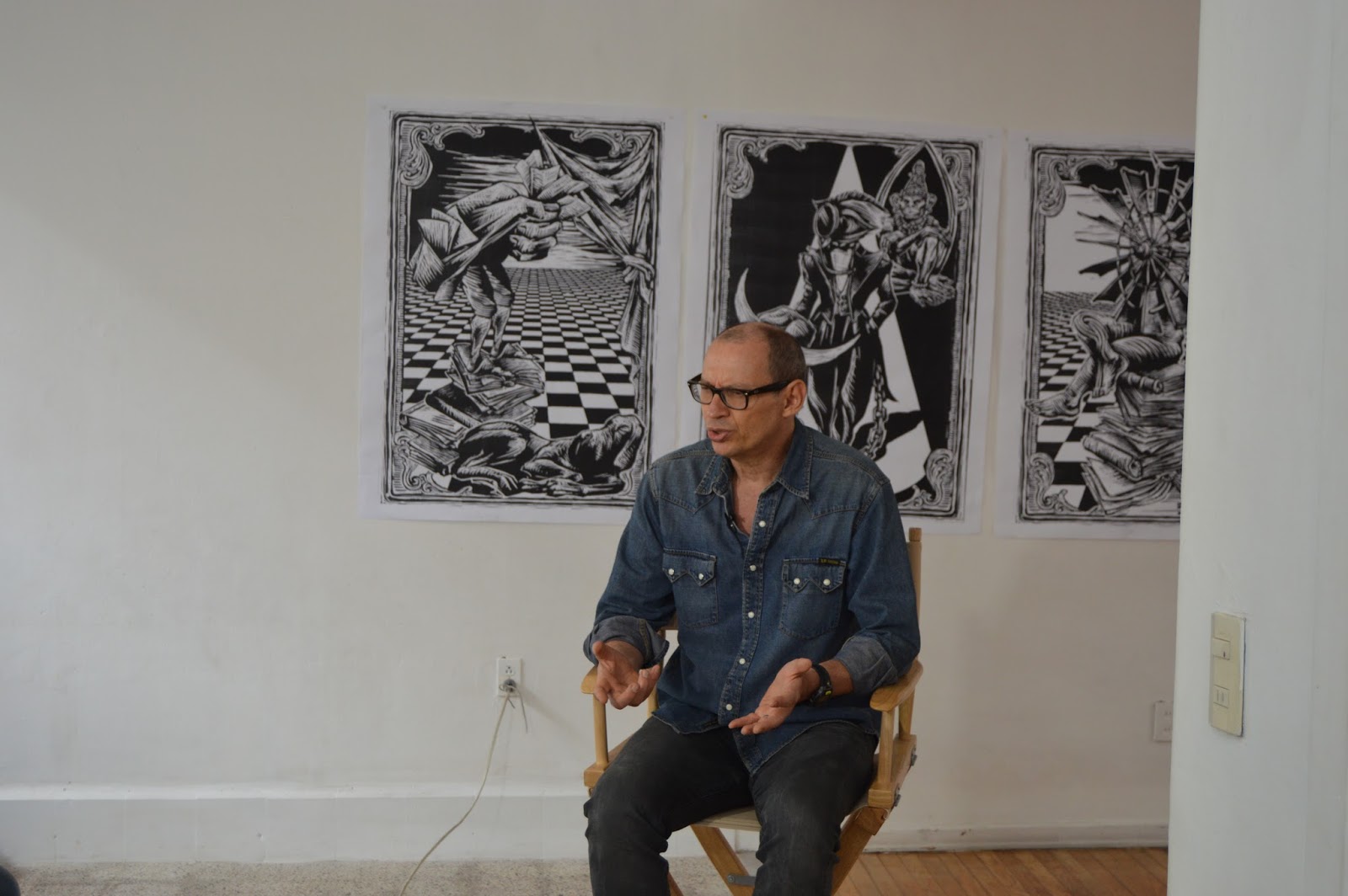
A propósito del trabajo del Quijote para Restless Books, el periodista Huemanzín Rodríguez me entrevistó para Canal 22. Fernando López "El Irrompible" del Estudio de Foto registró la conversación.


 |
| Huemanzin Rodríguez, Canal 22 con Eko. Foto Fernando López elestudiodefoto. |






Restless Books en Milenio por Alejandro Toledo
 |
| Alejandro Toledo, joyceano por excelencia, establece entre Cervantes y Joyce paralelismos en los espacios de imaginación pura dentro de la creación. Aparecido en Milenio Cultura el 26 de Mayo del 2015 |
Entérate y apoya el proyecto quijotesco de Restless haciendo click aquí.
| |||
|

La Pureza del Dibujo
...Y el dibujo lentamente se redujo a una disciplina para unos cuantos que pareciera que aún no encontraban la verdad en la que los otros se sumergían. Hoy dibujar es casi una actividad sectaria, dibujan sólo los que quieren hacerlo, ya dejó de ser el requisito fundamental de la formación del artista. (Avelina Lésper, El Dibujo).
 |
| Éste es el dibujo previo al grabado de Alicia. |
 |
| Alicia, el dibujo ya pasó por 2 procesos de intermediación, el grabado y las láminas de zinc de las rotativas de Milenio para el suplemento Laberinto. |
Eko Quijote en Newsweek

CULTURE
BY 5/19/15 AT 7:24 AM
 |
| Independent publisher Restless Books, headed by Amherst professor Ilan Stavans, launched a Kickstarter campaign to raise money for a new “Restless Classics” series. “Don Quixote” will be the first, with original woodcut illustrations by the artist Eko. EKO |
Picking up Don Quixote can be daunting, even for the biblio-inclined, and getting through its many hundreds of pages can be a heavy—not to mention lonely—task. But Ilan Stavans adores Miguel de Cervantes’s four-century-old classic, and he’d like to share with everyone the wonder of diving into the quirky tale of a middle-aged gentleman who sets out on a mission to court adventure and destroy evil.
Stavans, a humanities professor at Amherst College and publisher of Restless Books, has chosen his favorite book of all time as the first in a new series of “Restless Classics” from his similarly named independent publisher. Brooklyn, New York-based Restless Books, which has been in operation since last fall, launched a Kickstarter campaign Monday to raise $20,000 to print a new edition of Don Quixote, with original woodcut illustrations by the artist Eko.
But the series, whose tag line is “an interactive encounter with great books and inspired teachers,” doesn’t stop at the physical volumes. For each classic it publishes, Restless Books will release several videos featuring a scholar (in this case, Stavans) helping readers navigate through the book. They’ll give context, discuss characters and prepare readers for subsequent sections.
“I’m convinced that what we love when we read is not only the act of losing ourselves in the fantasy of the author but the capacity that we have to share that experience with others and talk about it,” says Stavans, who is originally from Mexico.
He hopes the videos can provide new readers—or repeat readers who’d like to see the book with fresh eyes—with clues from someone who’s read and reread the work many times over and devoted a great deal of time and thought to becoming an expert on a particular literary classic. The goal, though, is to accomplish this in “a casual way, conveying passion” rather than in a “snobby, pretentious lecture way,” he says, “so readers coming to the book now can be infected with that passion.”
The book itself will include an introduction from Stavans on Don Quixote and how the Restless Classics project is set up, a chronology of Cervantes’s life and work, and a gallery of thoughts from authors and other figures about Don Quixote. The accompanying videos will be released periodically over the course of about four months, starting in October to coincide with the publication of the new volume. As the videos are being rolled out, Stavans will also host a live online book discussion each month.
Four Centuries Later
Stavans and Restless Books chose Don Quixote not only because the professor adores it (and teaches a course on it at Amherst) but also to celebrate the 400th anniversary of the complete work. Cervantes published the first part of his story in 1605 and followed up with the second part a decade later. Next year will also mark 400 years since the author’s death, shortly after he finished what many consider the first modern novel.
“I think that there are two authors that really—I’m going to use the word invented—modernity. One of them is Shakespeare, and the other is Cervantes,” Stavans says, explaining that the depth and complexity of emotions these two were able to convey, and the extent to which they understood the inner lives of their characters, was unprecedented. Many of their successors learned from them.
Patricia Manning, a professor at the University of Kansas who studies 17th century Spain, believes that what made the novel so popular upon its publication is “quite similar to what piques our interest today,” pointing to attributes like the level of character development and a compelling narrative that can appeal to readers no matter what their favorite genre is.
“I think particularly the notion of Don Quixote himself: an aging man looking at life and not so happy...decides to remake himself. That’s certainly the type of plotline [we] can relate to,” says Manning, who is not involved in the Restless Classics project. “Also, the level of humor in the novel is really quite extraordinary.”
The first part of Don Quixote saw an unusual number of reprints for a book published in 1605, Manning says, and has continued to engage readers and inspire artists. There are movies, paintings, operas, ballets, theatrical productions, cartoons, statues and books for children and adults that were inspired by Cervantes’s novel. Even, Stavans says, a chain of discount stores in Japan (with three locations in Hawaii) and an asteroid with the name Don Quixote.
“I think it’s about how this book captures people’s imaginations. In all of us there’s a dreamer who wants to fix the world,” says Stavans, whose new book, Quixote: The Novel and the World, will be published in September, just prior to the Restless Classic release. In his cultural history of Cervantes’s novel, he explores “the ways in which a work of literature is a living thing that influences and is influenced by the world around it.”
“If you took Don Quixote out of Western civilization there would be a hole as deep and as complete as maybe taking out the moon,” Stavans says.
After kicking off its Restless Classics series this year with Don Quixote, the independent publisher plans to follow up with three more books in 2016 and five in 2017. Though Restless Books is still discussing what will be the next titles in the series, some options it’s considered for future publication are Robinson Crusoe by Daniel Defoe, Heart of Darkness by Joseph Conrad, Michel de Montaigne’s essays, and more works in Spanish as well as Hebrew and other languages.
They’ll choose a variety of classics, which Stavans defines as “astonishing works of literature that come from many countries” that are “able to speak to a diverse audience, represent universal values and offer a statement as to who we [are] as a civilization.”
“My dream is it has no boundaries,” Stavans says, alluding to his desire to go beyond English-language classics to those that come from Latin America, the Middle East, Asia and elsewhere, and identifying the audience he hopes to reach. The latter includes a college student, someone who has been meaning to tackle certain works since college, someone going on a cross-country trip who wants a literary travel companion, and a bona fide history buff.
When you’re reading a classic, Stavans says, “you become aware that many, many people have read it before you, and many more will read it after you. You’re part of a chain of readers that all coincide on the same page.”
Quijote por EKO Artista Contemporáneo
1 grabado del Quijote. Ya lo sé. Tiene calvas y la impresión es dispareja. El tórculo necesita una rectificada profunda. Cambiar esas llantas de caucho duro por valeros y la platina de baquelita por una plancha de fierro de calibre 4. Más chamba para don Alfonso Hernández. El bajo calibre 20 de la placa de cobre tampoco ayuda. El calibre ideal es de 18, te da muy buen golpe y no parece impresión digital. (Ojo cuando compres cobre en la Paloma, checa que te den el calibre que pagaste, a veces se "equivocan" y te dan menos calibre del que compraste)
 |
| EKO, Quixote. aguafuerte y aguatinta en placa de cobre, 2015. Proyecto para la coedición de Restless Books y Penguin. New York. Prólogo de Ilan Stavans. |
Eko Ex Libris James Ensor
Hoy la mierda es materia del Arte conceptual-curatorial. ¿Para qué quieres el voyeurismo privado del Rembrandt de la mujer cagando y orinando, si puedes presenciar a los activistas y performanceros en pleno exhibicionismo y además participar de la reflexión colectiva sobre el trending tópic del día?
 |
| Rembrandt La_femme_qui_pisse é dégonfler, etching 1631. |
Participar del exhibicionismo colectivo de ver cagar al artista del momento en un centro de Arte Contemporáneo, te hace virtuoso y avant-garde, te lleva más allá de tu limitada capacidad creativa y logra que tu "shit – the first solid thing that any of us makes – is sculpture". Tenemos el deber cívico de escandalizarnos ante esta rompedora manifestación del arte de nuestro tiempo. Aunque en secreto sigamos obsesionados con los grabados de Ensor. Otro artista decadente.
 |
| James Ensor 1889 Alimentation Doctrinaire 2ème planche Doctrinal Nourishment Second Plate |
Lo único que puedo hacer es admirar la audacia de éstos artistas de romper la frontera del lenguaje del grabado para tratar de descifrar el secreto de su inmortalidad.
 |
| Eko-James Ensor. Publicado en el Suplemento Cultural Laberinto No 620 |
Una placa de cobre
Cuando leí la reseña de un artista, encumbrado como el principal exponente de la "pintura expandida", yo ingenuo y crédulo, creí que se refiere a la pintura que se sale de la estrecha frontera del marco. Inmediatamente pensé en las escenografías de Salvador Dalí que ví en el MoMA Dalí Painting and Film.
Pero estaba equivocado, el artista y su six pack de curadores intérpretes se refieren literalmente a la pintura expandida. Al bote de pintura Comex, expandido en una superficie. La pintura de las paredes de tu casa es pintura expandida y puede llegar un artista conceptual y su curador a apropiársela y reclamarla como suya.
Entonces esta placa grabada que imprimí y publiqué hoy en Laberinto, de acuerdo a la estricta interpretación del arte conceptual-contemporáneo es una placa de cobre calibre 18. Nada más. El material es el tema. Y yo de pendejo me tomé la molestia de "intervenirla con aguatinta y aguafuerte" y además pasarla por un tórculo. Cuando sólo bastaba la placa o tal vez en una deriva conceptual, dónde la compré.
Dedicado a las enloquecidas amantes del pintor Arturo Rivera.
 |
| Salvador Dali Spellbound movie set. 1945. USA. Directed by Alfred Hitchcock |
Pero estaba equivocado, el artista y su six pack de curadores intérpretes se refieren literalmente a la pintura expandida. Al bote de pintura Comex, expandido en una superficie. La pintura de las paredes de tu casa es pintura expandida y puede llegar un artista conceptual y su curador a apropiársela y reclamarla como suya.
 |
| Eko Placa de cobre quemada con aguafuerte y aguatinta 2015. |
Entonces esta placa grabada que imprimí y publiqué hoy en Laberinto, de acuerdo a la estricta interpretación del arte conceptual-contemporáneo es una placa de cobre calibre 18. Nada más. El material es el tema. Y yo de pendejo me tomé la molestia de "intervenirla con aguatinta y aguafuerte" y además pasarla por un tórculo. Cuando sólo bastaba la placa o tal vez en una deriva conceptual, dónde la compré.
 |
| Tórculo obra del Maestro Alfonso Hernández -circa 1970- con mi asistente, el Master Printer. |
Dedicado a las enloquecidas amantes del pintor Arturo Rivera.
Eko Ex Libris Lamia
Todavía no intuyo el significado profundo del mito de Lamia, reina de Libia, amante de Zeus y víctima de los celos de Hera que -siempre adicta a sus emociones- le roba sus hijos. De acuerdo al poema de John Keats, Lamia enloquecida de tristeza y deseperación empieza a devorar niños lo que la convierte en daemón. Dedicado al Maestro Arturo Rivera, que ha retratado a Lamia en cada mujer que pinta.
Aunque éste otro dibujo podría ser Lamia, pero lo dediqué a la inmortalidad de los escritores. ¿Y cuál es el signficado onírico y premonitorio de ésta imágen? Las piernas abiertas como una prostituta son la Fama, porque la Fama no conoce la lealtad. Los niños muertos son proyectos que transforman el Destino de su autor y no existe compromiso y transformación mayor que la muerte. Probablemente, los griegos dedicaron la tragedia de Lamia a la inmortalidad de los creadores. Si és así, cuando este dibujo lo queme en un grabado hará inmortal la obra de quien lo posea.
Publicado en Laberinto gracias a la generosa complicidad de José Luis Martínez S.
 |
| Eko-Ex-Libris-Lamia, grabado aguatinta y aguafuerte en cobre. P/A |
Aunque éste otro dibujo podría ser Lamia, pero lo dediqué a la inmortalidad de los escritores. ¿Y cuál es el signficado onírico y premonitorio de ésta imágen? Las piernas abiertas como una prostituta son la Fama, porque la Fama no conoce la lealtad. Los niños muertos son proyectos que transforman el Destino de su autor y no existe compromiso y transformación mayor que la muerte. Probablemente, los griegos dedicaron la tragedia de Lamia a la inmortalidad de los creadores. Si és así, cuando este dibujo lo queme en un grabado hará inmortal la obra de quien lo posea.
 |
| Eko-ex-Libris-La-inmortalidad-de-los-escritores. Suplemeto Cultural Laberinto. |
Publicado en Laberinto gracias a la generosa complicidad de José Luis Martínez S.
Eko Ex Libris Nessus y Deianira
Rubens de nuevo. Estudiar a los artistas clásicos hoy, se ha convertido en una postura ética. Y antipopular. Lo de hoy, es tomarse en serio las declaraciones del señor Francis Alÿs "La magia de la operación artística consiste en que cuando presentas un objeto en un contexto determinado se puede volver arte." (Entiéndase por magia, el enchufe). Por eso los chorritos de pintura son arte porque están en un museo. De acuerdo con esta actitud, que es la postura oficial del Establishment Académico-Galerístico-Estatal, si el cuadro de Rubens: Nessus y Deianira lo vi en la Royal Academy, es Arte; si lo vi impreso en el catálogo, es ilustración porque es un libro; y si está publicado en el periódico es cartoon. Si es video es arte, pero si es dibujo es manualidad, como el macramé. La versión publicada en Laberinto:

El apunte:

La fuente original:
El apunte:
La fuente original:
 |
| Nessus and Deianira 82 x 63.5 cm Oil on canvas transferred from panel State Hermitage Museum, St. Petersburg |
Ex Libris de Virginia Woolf
 |
| Publicado en Laberinto, gracias a la complicidad de su editor y amigo Fosé Luis Martínez S. |
Ayer fue aniversario del suicidio de Mrs Woolf, por lo menos de la publicación de su obituario, ya que llevaba desaparecida 5 días desde el 28 de marzo, seguramente el día que murió. Encontraron a la orilla del río Ouse su paraguas y su sombrero, su cadáver fue arrastrado por las verdosas aguas del río.

Suscribirse a:
Entradas (Atom)
Lord Ganesh protege a los libros con lectores
Los libros cobran vida cuando los abro, y empiezan a platicar desde la primera letra. Estamos contenidos en los libros, lo demás es ceniza....

-
Los libros cobran vida cuando los abro, y empiezan a platicar desde la primera letra. Estamos contenidos en los libros, lo demás es ceniza....
-
 Además de librero fue un chingón editor. Conservo 2 libros editados por City Lights . Muy amigo de mi cuate Carlos Martínez Rentería el Fer...
 -
 Como sabemos que el futuro aún no existe, el único presente de Caperucita es el Lobo Feroz. Publicado en Laberinto, suplemento de Milenio D...
 -
 Reseña publicada en Laberinto , suplemento de Milenio Diario, 8, enero 2011 Reseña publicada por Ángel González en El Gráfico de El Univer...
 -
 Publicado en Laberinto gracias a la condescendiente paciencia de José Luis Martínez S.
 -
Durge, hizo posible destruir los enemigos técnicos del color masivo; es un homenaje a la impresión a 4 colores de hace 70 años, y por eso el...
-
 Los caireles infinitos de Rapunzel, y mi fallida búsqueda de esos caireles. Alguien la ha visto? El original, Y la versión Rapunzel infini...


